
How Can Background Contrast Improve Aura Viewing Practice?
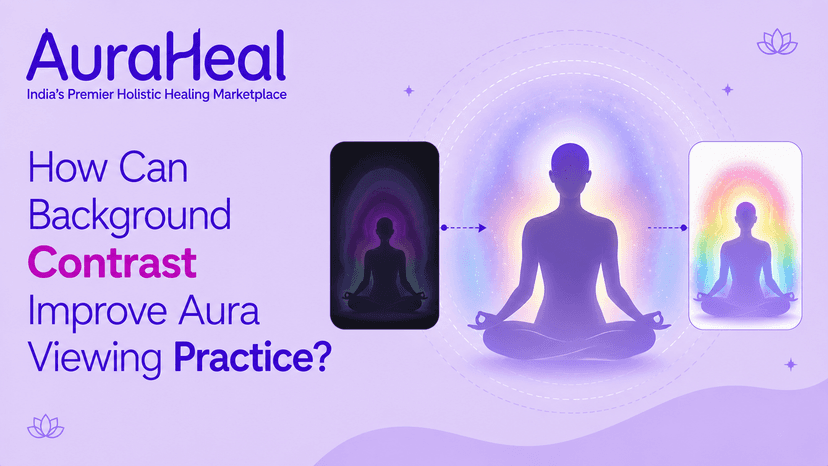
Aura viewing is commonly considered a subtle practice that requires a lot of patience and attention. Regardless of whether you consider aura viewing as a spiritual practice or a technique for intuitive perception of the world, the environment can have an impact on the process. One of the most accessible factors that you can change is the background for the observation.
A plain background can simplify the practice of aura viewing by eliminating visual distractions and creating a clear background against which faint outlines or changes in light may be observed. Instead of numerous details like patterns, furniture, bright colors, or dark shadows that draw your attention, a plain wall creates a more comfortable visual background. Learn more about how background contrast works and how lighting, distance, and simple exercises can improve your practice.
Why Background Contrast Can Be Useful During Aura Viewing
If there is a complex background during the observation, your brain will need to process numerous shapes, colors, shadows, and textures, thus creating more visual distractions. The plain background reduces the amount of such stimuli for your eyes and makes the perception more comfortable.
Many aura viewing techniques recommend the use of white, off-white, beige, or light gray background because such a color allows creating a homogeneous visual background where the faint outline or hazy aura might be easier to notice. The purpose is not to force the aura into visibility but to create an appropriate environment where you can observe comfortably.
Also Check: Aura Photography Explained: Can Energy Fields Really Be Seen?
How the Simple Background Helps to Reduce Visual Distractions
A wall that is painted with images, patterns, shelves, or even has strong shadows gives your eye plenty of detail to look at. A plain and light-colored wall does not give you that much visual input, making it much easier to examine your surroundings.
It is particularly helpful if you start practicing aura reading and learn to distinguish subtle impressions from ordinary optical effects. The busy patterns can also create afterimages and color effects which might be mistaken for the colors of the aura.
The Role of Background Contrast in Peripherical Vision
Peripherical vision plays an essential role in traditional aura reading practices. Instead of focusing directly on the person, you should gently focus on the point which is located aside or above this person and let the peripheral vision perceive the space around the body.
Ask your friend to stand two to three meters away in front of the light-colored wall. Focus on the point which is situated above the shoulders of this person and relax your vision. Some people report the presence of a faint white, blue, or translucent outline, while others do not notice anything at all. The main thing is to observe without putting pressure on yourself.
Choosing the Appropriate Background for Aura Practice
The simplest background can be the most effective one. Plain white, off-white, light gray, or soft beige walls create the background that is almost free of visual distractions.
It is better to avoid:
Busy wallpaper and geometric patterns
Bright artworks located behind the subject
Reflective surfaces and strong shadows
Flickering lights
Continuous motion through the window
Very dark or extremely colored walls
The only thing you should do is keep the environment free from unnecessary details.
Lighting is Also Important for Aura Viewing
Background contrast is most effective in combination with comfortable lighting. Overhead lights can create numerous shadows, while observation in complete darkness can make the subject invisible.
It is better to have soft and indirect lighting, which usually looks most comfortable. Natural daylight is suitable if it is not too bright, while early mornings or late afternoons can provide more comfortable lighting. In case of indoor observation, the subject should be protected from direct sunlight and have soft and even lighting.
The Importance of Distance
Distance can influence the aura viewing practice. Being too close, you will be forced to pay attention to physical details, while being too far away, the subject becomes barely visible.
A distance between two and three meters can be appropriate when you practice with another person. This allows observing the head and shoulders of the subject while having enough space around the body for peripheral observation.
A Simple Aura Viewing Exercise for Beginners
Ask a friend to stand relaxed in front of a blank wall. Step away several feet, breathe a couple of times deeply, and relax your face and eyes. Choose a spot that is slightly above one of their shoulders, but do not look straight into their eyes. Fix your central vision on this point and use peripheral vision to look at everything else.
Don’t try to see any color immediately. You might notice a shimmer, an outline, a difference in brightness, or nothing – simply observe and rest your eyes.
Try Practicing with Your Hands
You do not have to involve another person to start practicing aura viewing. The easiest way to do this is to use your hands. Put your hands on a plain and light background and slowly move your fingers apart.
Observe the space around your hands with relaxed eyes. Some people report a faint glow or outline; however, visual illusions, like afterimages, can create an illusion of halos. That is why close observation is important.
Why Beginners Shouldn’t Chase Aura Colors
One of the mistakes beginners tend to make is to expect bright colors right away. People who claim they saw auras report their experience as a faint haze, translucent border, shimmering, or light outline.
Red stands for vitality, orange for creativity, yellow for mental activity, green for harmony, blue for calmness, and purple/violet for spirituality, according to traditional aura interpretation. These associations are characteristic of different spiritual practices and shouldn’t be considered medical or psychological diagnostics. Your aim should be to practice calm observing.
Common Mistakes That Might Hinder Your Practice
Aura viewing is a process of patience and relaxation, especially when you’re just starting to learn how to observe. Avoiding a few common mistakes can make your practice more comfortable and consistent.
Staring Too Hard: Don’t try to focus your eyes hard, because you might end up straining them.
Using a Busy Background: Patterns, pictures, colors, and other distractions can make faint outlines or halos invisible.
Practicing in Harsh Lighting: Overhead lights and shadowed areas are distracting and hinder your visual field, so try to practice in soft and even lighting conditions.
Expecting Immediate Results: Aura viewing is usually a gradual process, so give yourself time to get used to soft focus and peripheral vision.
Misinterpreting Visual Effects: Halos, colors, and afterimages can be explained in an ordinary way, so don’t jump to conclusions and observe them carefully.
Conclusion
A good aura viewing place starts with simplicity, and a blank wall is a good way to reduce distractions and create a peaceful visual field. Soft lighting, proper distance, peripheral vision, and relaxed eyes can make your practice easier and more consistent.
Halos and colors might have an ordinary optical explanation, so try to observe them carefully and patiently. Regular practice will help you develop your mindful technique of aura exploration. Want to explore your energy further? Book a session today with our experts at AuraHeal.
Keep Exploring

Larimar: Meaning, Properties, Uses and Crystal Care!
Larimar is a rare blue crystal associated with calmness, clear communication, emotional balance, and inner peace.

Green Aventurine: Meaning, Properties, Uses and Crystal Care
Green Aventurine is a green crystal associated with luck, prosperity, emotional balance, personal growth, and positive energy.

Kambaba Jasper: Meaning, Properties, Uses and Crystal Care!
Kambaba Jasper is a dark green stone with distinctive black circular patterns, traditionally associated with grounding, calmness, and emotional balance.
Ready to Realign Your Energy?
Discover the root cause of your energetic blocks with Babita Ji — experience a profound shift completely complimentary.
Book Free Session Now