
Does Science Really Support the Existence of Auras?
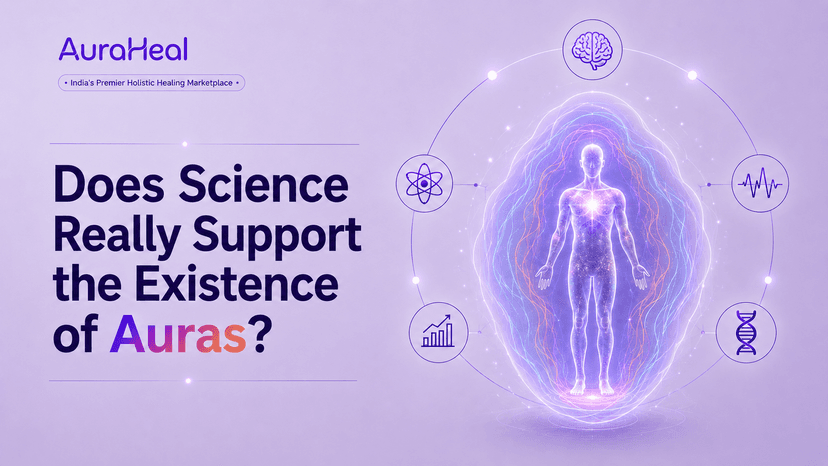
From the shimmering halo over a medieval saint to the vibrant colors surrounding a meditating yogi to the colorful, cloud-like aura encircling a mysterious figure, we have all seen the imagery in one form or another. Despite having never seen one with your very own eyes, the concept of an aura has firmly cemented itself in the cultural vocabulary of our society. It is used to describe somebody’s “energy” and, therefore, people are said to either have a “dark aura” or a “radiant aura” based on their behavior and demeanor.
But when do metaphors cease and reality starts? According to countless mystics, energy healers, and clairvoyants, the human aura is something real, something material, an invisible field of luminous energy that envelops the entire human body and directly mirrors our physical wellbeing and state of mind. In other words, according to these claims, the existence of the human energy field is an absolute fact. On the contrary, mainstream science has been debunking the aura for decades and labeling it a pseudoscientific invention.
In this article, we will discover what modern science can say about the human aura and the way in which it is revolutionizing an ancient mystery into a cutting-edge phenomenon in human biology.
Understanding the Rich History of the Radiant Body
In Ancient Greece, the word αὔρα (aura) referred to both a soft breeze and a subtle exhalation of breath. Moreover, there was a mythological nymph named Aura, the embodiment of the fast and gentle motion of the wind.
With time, this word became used to refer to anything existing between the tangible matter that composes our body and something utterly invisible, spiritual. Over the years, the idea of the existence of an aura became a part of every artistic and spiritual tradition, being used to distinguish a person as extraordinary.
A Cross-Cultural Legacy of Subtle Anatomy
As it was mentioned earlier, the idea of the aura was shared among multiple traditions throughout centuries and had different names:
Eastern Traditions: In India, scholars discussed the concept of the subtle body called sūkṣma śarīra in the Upanishads. It included such elements as pranamayakośa (breath-body/life-force sheath), which shows the movement of energy beyond our physical skin layer. Similarly, Traditional Chinese Medicine refers to the movement of qi (life-energy) beyond our body as well.
Ancient West and Medicine: Even Aristotle struggled with the notion of dualism and invented the concept of a mediator, which he called phantasmic pneuma. This mediator represented a casing made of star-like substance that helped the human soul interact with the material world around us. Moreover, the famous Greek physician Galen used the term in the 2nd century CE to discuss the experience right before an epileptic seizure; this concept exists in neurology to this day and is called a medical aura.
Hermeticism: In the Renaissance period, natural philosophers and magicians like Paracelsus, Marsilio Ficino, and Giordano Bruno turned to Neoplatonic philosophy to describe an invisible network of influences. They claimed that humans constantly exchanged invisible fluids and matter with planets and stars.
The Democratization of the Concept
Throughout most of human history, such radiation existed only in deities, saints, or holy men. However, a great cultural change happened at the end of the 19th and the beginning of the 20th century due to the development of the Theosophical Society. Numerous esoteric authors and alternative medicine practitioners like Auguste Jean Baptiste Marques published treatises such as The Human Aura: A Study in 1896.
Marques and others spread the knowledge about diagrams depicting a common human silhouette surrounded by multiple colored cloud-like arches. These layers were given specific names derived from Tantric idioms like the "kamic sheath" culminating in an outermost boundary called the "auric egg."
Physical Truth – What We Really Give Off
With the traditional aura debunked as nothing more than a physical impossibility, the question arises as to what, then, are aura readers seeing? In order to understand this, one must examine the reality of the human body.
Our Bodies and Aura
We are not closed-off units but rather are thermodynamically open organisms constantly emitting an intricate chemical profile into the air surrounding us.
Human Body Chemistry
At any given time, our bodies are constantly producing an incredibly diverse collection of chemicals which create an invisible, yet localized cloud.
Learn More: 7 Warning Signs Your Aura May be Blocked or Out of Balance!
Why is this Chemistry Invisible to the Eye?
So, if we are always surrounded by such an intricately complicated cloud of organic compounds and lipids, why cannot we see the chemical aura? The reason lies in the physics behind sight.
For anything to be seen by the human eye, its component parts must scatter light to varying degrees. The individual lipids and gases that are continuously released by our bodies are simply too small to affect the wavelengths of light.
In addition to requiring light-scattering capabilities, these chemicals would have to either fluoresce or phosphoresce to be seen under normal circumstances. As such, these emissions simply dissipate into the air as we move about. More compelling evidence, however, comes in the form of scientific testing.
Conclusion
A close examination of the facts presented here reveals that the long-held argument between the scientific community and the spirit-world believers about the existence of the human aura is starting to blur. On one side, science proves definitively that there is no mystical, invisible aura of glowing energy encasing the human body.
Yet, it simultaneously proves that we are never truly contained within the boundary of our skin. If you're curious about your own energy field, book a personalized aura reading or healing session with AuraHeal's experienced healers and receive guidance tailored to your unique journey toward balance and self-awareness.
Keep Exploring

Larimar: Meaning, Properties, Uses and Crystal Care!
Larimar is a rare blue crystal associated with calmness, clear communication, emotional balance, and inner peace.

Green Aventurine: Meaning, Properties, Uses and Crystal Care
Green Aventurine is a green crystal associated with luck, prosperity, emotional balance, personal growth, and positive energy.

Kambaba Jasper: Meaning, Properties, Uses and Crystal Care!
Kambaba Jasper is a dark green stone with distinctive black circular patterns, traditionally associated with grounding, calmness, and emotional balance.
Ready to Realign Your Energy?
Discover the root cause of your energetic blocks with Babita Ji — experience a profound shift completely complimentary.
Book Free Session Now